Types of Trademark in India: Word Marks, Logos, Sound Marks & More (With Examples)

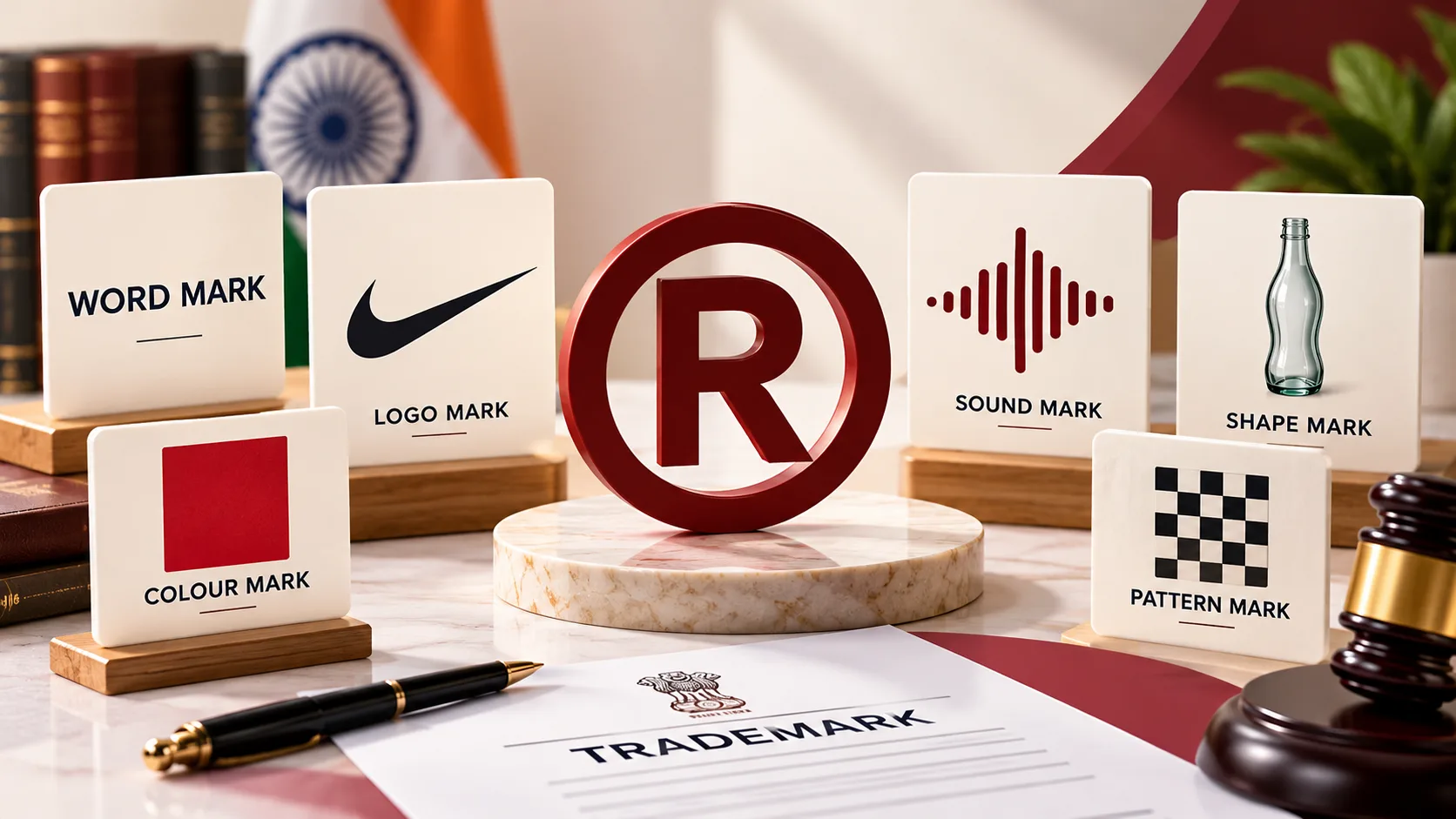
When most people hear “trademark,” they picture a logo. Makes sense. Logos are everywhere. But trademarks go far beyond that. In India, you can trademark a word, a sound, a colour, a shape, and as of late 2025, even a smell.
What Counts as a Trademark Under Indian Law?
Section 2(1)(zb) of the Trade Marks Act, 1999 defines a trademark as “a mark capable of being represented graphically and which is capable of distinguishing the goods or services of one person from those of others.” That’s the legal language. In plain terms: if it helps your customer tell your product apart from someone else’s, it can potentially be a trademark.
The word “mark” itself gets a wide definition under Section 2(1)(m). It includes devices, brands, headings, labels, tickets, names, signatures, words, letters, numerals, shapes of goods, packaging, and combinations of colours. That’s a long list, and courts have been expanding it over the years.
The key test is distinctiveness. Can the mark identify the source of goods or services? If yes, it qualifies. If it’s too generic or descriptive, registration gets difficult.
TM vs ®: A Quick Distinction
You’ll see both symbols used by businesses. Here’s the difference.
TM (™) can be used by anyone, anytime. It simply signals that you’re claiming a word, logo, or other element as your trademark. No registration needed. It gives you common law rights but limited legal muscle if someone copies you.
® is different. You can only use this symbol after your trademark has been officially registered with the Trade Marks Registry. Using ® without registration is a criminal offence under Section 107 of the Act, punishable with imprisonment up to three years.
Types of Trademarks Recognised in India
Let’s walk through each type with real examples. Some of these are straightforward; others might surprise you.
1. Word Marks
A word mark protects the word itself, regardless of font, colour, or design. Register “TATA” as a word mark and it’s protected in any font, any size, any colour. That’s the strength of a word mark: broad protection for the name alone.
Word marks are what most startups should file first. Your brand name is usually the first thing customers remember, and protecting it early prevents someone else from registering something identical or deceptively similar.
- TATA
- INFOSYS
- ZOMATO
- RELIANCE
- AIRTEL
2. Device Marks (Logos)
A device mark protects a visual symbol or logo. Think of the Amul girl, the Air India Maharaja, or the Kingfisher bird. These marks work purely through visual recognition. You don’t need to read anything; you see the logo and know the brand.
Device marks are powerful for consumer-facing brands, especially in markets where literacy levels vary. A well-designed logo communicates identity without a single word.
One catch: protection applies to that specific visual. Change the logo significantly and you may need a fresh application.
- Amul girl
- Air India Maharaja
- Nike swoosh
- Apple logo
3. Composite Marks
Composite marks combine a word and a device into a single mark. The Starbucks logo with its siren and the brand name is a composite mark. So is Kingfisher’s logo with the bird and the word “Kingfisher” together.
The advantage? You protect both elements in one application. The trade-off? If someone copies just the word or just the logo, enforcement can get trickier compared to having separate registrations for each.
- Starbucks (name + siren)
- Kingfisher (name + bird)
- Pepsi (name + globe)
4. Shape Marks (3D Trademarks)
If the shape of your product or its packaging is distinctive enough, it can be trademarked. The classic Coca-Cola contour bottle is the textbook example. Toblerone’s triangular prism packaging is another.
Getting a shape mark registered is harder than a word or device mark. You need to prove that consumers associate that specific shape with your brand, not just with the product category. A generic bottle shape won’t cut it.
- Coca-Cola bottle
- Toblerone triangle
- Zippo lighter shape
5. Sound Marks
Yes, sounds can be trademarked. Netflix’s “ta-dum,” the Yahoo! yodel, and ICICI Prudential’s jingle are all protected sound marks. The Indian Trade Marks Registry accepts sound mark applications, provided you submit a sound clip in MP3 format along with a musical notation or description of the sound.
The sound has to be distinctive and associated specifically with your brand. Generic tunes, national anthems, and common musical phrases won’t qualify. In our experience, businesses with strong audio branding (media companies, fintech apps, telecom operators) benefit the most from sound marks.
- Netflix “ta-dum”
- Yahoo! yodel
- MGM lion’s roar
- ICICI Prudential jingle
6. Colour Marks
A single colour or combination of colours can function as a trademark if it’s become so associated with a brand that consumers instantly recognise it. Cadbury’s purple (Pantone 2685C) and Tiffany’s robin-egg blue are well-known examples globally.
Colour marks are among the hardest to register. You need strong evidence of “acquired distinctiveness,” meaning years of consistent use that has built an automatic connection between the colour and your brand in the public’s mind. A colour that’s common in your industry (green for organic products, for example) won’t get through.
- Cadbury purple
- Tiffany blue
- Christian Louboutin red sole
7. Smell Marks (Olfactory Trademarks)
This is the newest frontier. Can you trademark a fragrance? In India, the answer is now yes.
In November 2025, the Controller General of Patents, Designs & Trade Marks accepted India’s first smell trademark: a floral fragrance reminiscent of roses, applied to tyres. The applicant was Sumitomo Rubber Industries Ltd. (Kobe, Japan), filed under Application No. 5860303 on March 23, 2023.
The interesting part is how they satisfied the “graphical representation” requirement. Sumitomo used a 7-dimensional olfactory vector developed by researchers at IIIT Allahabad, essentially a scientific graph that maps the scent. This approach worked where simple word descriptions of smells had failed in the past.
The legal basis sits in Sections 2(1)(m) and 2(1)(zb) of the Trade Marks Act. The UK had granted a similar mark back in 1996 (UK00002001416), but India’s acceptance signals that the registry is now open to non-traditional marks.
- Sumitomo rose-scented tyres
- Play-Doh scent (US)
8. Certification Marks
Certification marks aren’t owned by the businesses that display them. They’re owned by an authority or standards body that certifies certain qualities. The ISI mark, the BIS hallmark on gold jewellery, the FPO mark on food products, and the Woolmark logo all fall here.
Any manufacturer who meets the standards can use the mark. The certifying body controls quality, not the production.
- ISI mark
- BIS hallmark
- Woolmark
- FPO mark
9. Collective Marks
Collective marks identify goods or services as coming from members of a particular association or group, rather than a single company. The “CA” mark of the Institute of Chartered Accountants of India and the Darjeeling Tea logo are examples.
Only members of the association can use the mark, and the association sets the rules. It’s a useful tool for industry groups, cooperatives, and geographical producer associations.
- CA (ICAI)
- Darjeeling Tea logo
- CII mark
Types of Trademarks: Comparison Table
| Type | What It Protects | Example | Best For | Registration Difficulty |
|---|---|---|---|---|
| Word mark | The word/name itself | TATA, ZOMATO | Startups, service firms | Low to moderate |
| Device mark | Logo or visual symbol | Amul girl, Nike swoosh | Consumer brands, FMCG | Low to moderate |
| Composite mark | Word + logo together | Starbucks, Pepsi | Brands with strong visual identity | Moderate |
| Shape mark | 3D shape of product/packaging | Coca-Cola bottle | Product manufacturers | High |
| Sound mark | Audio signature or jingle | Netflix “ta-dum” | Media, fintech, telecom | High |
| Colour mark | Single colour or combination | Cadbury purple | Established brands with years of use | Very high |
| Smell mark | Fragrance applied to goods | Sumitomo rose-scented tyres | Niche product differentiation | Very high |
| Certification mark | Quality/standard compliance | ISI mark, Woolmark | Standards bodies, regulators | Moderate (different rules apply) |
| Collective mark | Association membership | CA (ICAI), Darjeeling Tea | Industry groups, cooperatives | Moderate (different rules apply) |
Which Trademark Type Should You Pick?
This depends on your business stage and what your customers actually recognise about you.
If you’re a startup or new business
Start with a word mark. Your brand name is your primary identifier at this stage, and a word mark gives you the broadest protection. You can file a device mark later once your logo is finalised and your visual identity has matured. Many startups rebrand their visuals in the first few years. If you’ve already registered a logo that you later change, you’ll need to file again.
If you’re a consumer-facing brand
Consider filing both a word mark and a device mark separately. This gives you independent protection for each element. If someone copies your name in a different logo, the word mark covers you. If someone uses a suspiciously similar logo with a different name, the device mark covers you.
If you’re in media, tech, or entertainment
Sound marks are worth thinking about. If your app, channel, or platform has a signature sound that plays at startup or during transitions, protecting it prevents competitors from creating confusingly similar audio cues.
If your product has a distinctive physical form
A shape mark could add a layer of protection beyond a standard patent or design registration. But you’ll need evidence that consumers identify the shape with your brand specifically.
Protecting Your Trademark on E-Commerce Platforms
Here’s something that doesn’t get enough attention. You can have a registered trademark and still find counterfeit or unauthorised products using your brand on Amazon, Flipkart, or Meesho. Registration is the first step, but enforcement is what actually stops the damage.
Three recent cases show what’s at stake.
Reliance/Jio vs unauthorised sellers (July 2025)
The Delhi High Court directed Amazon, Flipkart, and Meesho to delist products that were using Reliance and Jio trademarks without authorisation. The court also ordered the platforms to hand over seller details. The sellers had no licence to use the marks, and the platforms were facilitating the infringement by hosting their listings.
Amazon and the Beverly Hills Polo Club penalty (February 2025)
This one made headlines. The Delhi High Court ordered Amazon to pay approximately $39 million (around ₹340 crore) to Lifestyle Equities for trademark infringement related to the “Beverly Hills Polo Club” mark. The case highlighted that platforms can face direct liability for facilitating sales of infringing goods, not just the individual sellers. (This order was later stayed on appeal, but the message to platforms was clear.)
Happi Planet counterfeit injunction (January 2026)
Happi Planet, an eco-friendly personal care brand, obtained an ex parte injunction from the Delhi High Court against counterfeiters selling fake products on Amazon, Flipkart, Meesho, and Jiomart. The court found the counterfeit packaging “so identical that it took a while for this Court to distinguish between the two.” Notably, the court granted a dynamic injunction, meaning new infringing listings can be reported and removed directly without going back to court each time.
Frequently Asked Questions
How many types of trademarks are there in India?
Which trademark type is best for a startup?
Can you trademark a smell in India?
What is the difference between TM and the ® symbol?
Can I register more than one type of trademark for the same brand?
How do I protect my trademark on Amazon, Flipkart, or Meesho?
Need Help Choosing or Registering Your Trademark?
Lexgin’s trademark team handles searches, filing, and enforcement across all trademark types. Whether it’s a word mark for your startup or a sound mark for your platform, we’ll get it right the first time.
Disclaimer: This article is for informational purposes only and does not constitute legal advice. Trademark laws and procedures may change. For advice specific to your situation, consult a qualified trademark attorney. Government fees and timelines mentioned are subject to revision. Contact Lexgin to verify current requirements.