Copyright Registration in India – Process, Fees, Timeline & Copyright Office Guide

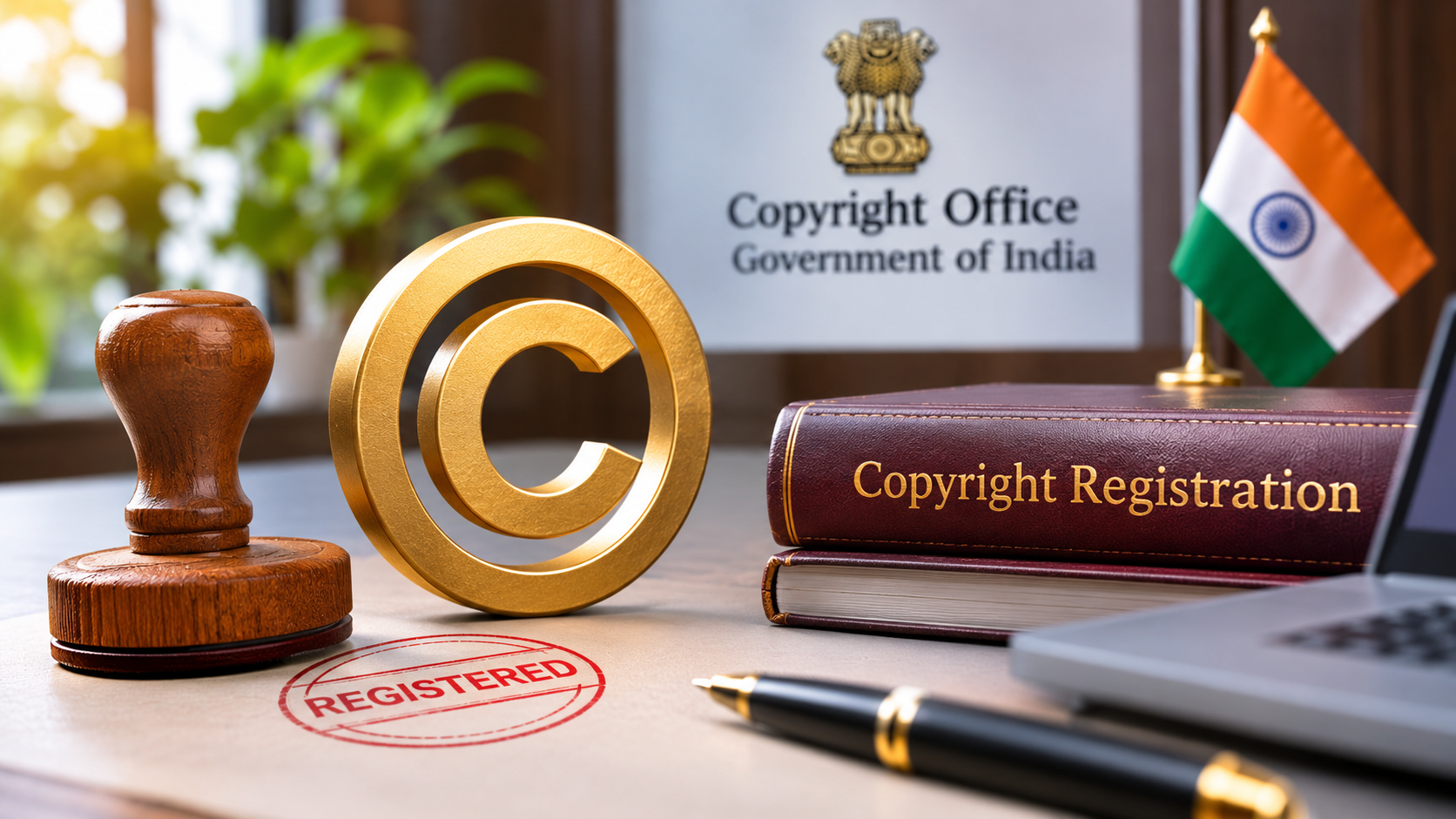
Here’s something that surprises most creators: your work is already copyrighted the moment you create it. A song you compose, code you write, a painting you finish, a research paper you publish. Under the Copyright Act, 1957, protection kicks in automatically. No filing. No stamp. No registration.
Because “automatic protection” and “enforceable protection” are two different things. Try proving ownership in a copyright infringement suit without a registration certificate, and you’ll understand the gap. Registration creates a public record and gives you prima facie evidence of ownership. In a dispute, that distinction can be worth lakhs.
This guide walks you through the entire registration process at the Copyright Office, the fees by work type, documents you’ll need (including the NOC from your institution), and how to track your application status online.
Govt fee for literary/artistic works
Mandatory waiting period
Typical registration timeline
Protection after author’s death
What Does Copyright Protect in India?
The Copyright Act, 1957 protects original works in six categories. Each category has its own rules for duration, ownership, and what qualifies:
- Literary works – Books, articles, computer programs (yes, software counts as a literary work under Indian law), tables, compilations, databases, and letters. This is the broadest category.
- Dramatic works – Scripts, screenplays, stage directions, mime sequences, and choreographic notations. A dramatic work is any piece meant for performance.
- Musical works – Compositions and musical notation. Not the lyrics (those fall under literary works) and not the recorded version (that’s a sound recording). The composition itself.
- Artistic works – Paintings, sculptures, drawings, engravings, photographs, architectural designs, and works of artistic craftsmanship. Quality doesn’t matter here. A child’s drawing and a Husain painting both qualify.
- Cinematograph films – Any work of visual recording, on any medium. This covers feature films, short films, documentaries, and YouTube videos.
- Sound recordings – A recording of sounds, regardless of the medium. The recording itself is a separate copyright from the underlying composition and lyrics.
Automatic Copyright vs. Registered Copyright
Copyright exists from the moment of creation. That’s the law. But what happens when someone copies your work and denies it?
Without registration, you’ll need to build your ownership case from scratch. Timestamps on files. Email trails. Witness statements. It’s messy, time-consuming, and the outcome isn’t guaranteed.
With registration, you walk into court with a certificate that serves as prima facie evidence of ownership under Section 48 of the Copyright Act. The burden shifts to the other party to disprove your claim.
Five reasons registration is worth it
- Legal presumption of ownership. The registration certificate is admissible evidence. Courts treat it as proof unless contradicted.
- Public record. Your work enters the Register of Copyrights, creating an official timestamp that nobody can dispute.
- Easier enforcement. Filing a copyright infringement case is far simpler when you have a registration number to point to.
- Licensing and monetisation. Licensees and publishers prefer registered works. It gives them confidence that you actually own what you’re licensing.
- International recognition. India is a member of the Berne Convention. Your registration strengthens your position when enforcing rights abroad.
At ₹500 per work for most categories, there’s honestly no good reason to skip registration.
Copyright Registration Fees (Government Fees)
Fees are set under the Second Schedule of the Copyright Rules, 2013. Unlike patent filing, copyright fees are flat rates per work. No applicant category distinction. No difference between individual and company filings.
| Type of Work | Registration Fee (per work) |
|---|---|
| Literary, dramatic, musical, or artistic work | ₹500 |
| Artistic work used for goods/services (Section 45) | ₹2,000 |
| Sound recording | ₹2,000 |
| Cinematograph film | ₹5,000 |
| Changes in particulars (literary/dramatic/musical/artistic) | ₹200 |
| Changes in particulars (sound recording) | ₹1,000 |
| Changes in particulars (cinematograph film) | ₹2,000 |
Payment can be made by demand draft, Indian postal order, or online through the copyright.gov.in portal. The demand draft should be drawn in favour of “Registrar of Copyrights, New Delhi.”
Step-by-Step Copyright Registration Process
The entire process runs through the Copyright Office under the Department for Promotion of Industry and Internal Trade (DPIIT). Here’s exactly how it works:
- Prepare Form XIV and supporting documents
Form XIV is the standard application for copyright registration. You’ll also need to fill out the Statement of Particulars and Statement of Further Particulars. One important thing: the applicant must sign these forms personally. Your agent or attorney can’t sign on your behalf. Before filing, get all your documents in order (full list below). - File online at copyright.gov.in or by post
You can file online through the Copyright Office portal at copyright.gov.in, or send your application by registered post or speed post to the Copyright Office in New Delhi. In-person filing at the office is also accepted. Online filing is faster and gives you immediate confirmation. Each application covers one work. Want to register five songs? That’s five separate applications. - Receive your Diary Number
Once the application is accepted, you’ll get a Diary Number. Think of it as your tracking ID. It’s not a registration certificate. It’s just proof that the Copyright Office received your application and a reference number for all future correspondence. - 30-day mandatory waiting period begins
Under Rule 70(10) of the Copyright Rules, there’s a mandatory 30-day objection window. During this period, anyone who claims an interest in the work or disputes your rights can file an objection. The Copyright Office also sends a notice to relevant interested parties under Rule 70(9). This waiting period is non-negotiable. You can’t expedite it. You can’t skip it. Every application goes through it. - Examination by the Registrar
If no objection comes in during the 30-day window, the Registrar’s examiner checks your application for completeness and accuracy. They’ll verify the documents, the work category, the ownership chain, and whether anything is missing or incorrect. If the examiner finds issues, you’ll receive a discrepancy letter asking you to rectify the problems within a set timeframe. Don’t ignore this. Failure to respond can lead to rejection. - Hearing (only if objections are filed)
If someone files an objection, the Registrar holds an inquiry under Rules 70(11) and 70(12). Both parties get a hearing. The Registrar will not reject an application without giving the applicant a chance to respond. - Registration certificate issued
If the examiner is satisfied (and no unresolved objections remain), the Registrar enters the particulars in the Register of Copyrights and signs the entry. A copy of this signed Register entry is your registration certificate. Under Rule 70(13), this signed extract is the official proof of registration.
Documents Required for Copyright Registration
Missing documents are the number one reason applications get delayed. The Copyright Office doesn’t assume anything. If it’s not in the file, it doesn’t exist. Here’s the complete list:
For all work types
- Form XIV (signed by the applicant in person)
- Statement of Particulars and Statement of Further Particulars
- Two copies of the work (published or unpublished)
- Prescribed fee (as per the table above)
- NOC from the author (if the applicant owns copyright but is not the author)
- Power of Attorney / Vakalatnama (if filing through a registered agent)
- Proof of identity and address of the applicant
Additional documents by work type
- Computer programs: First 10 and last 10 pages of source code (or full code if under 20 pages). No redactions allowed.
- Sound recordings: Copy of the rights agreement, or separate NOCs from lyricist, composer, performers, and director if no single agreement exists.
- Cinematograph films: Copy of the rights agreement with all contributors, or individual NOCs from each rights-holder.
- Artistic works used for goods/services: A declaration in Form XIV plus a TM-C certificate from the Trade Marks Registry.
- Artistic works capable of design registration: Affidavit under Rule 70(7) confirming the design hasn’t been applied to more than 50 articles.
NOC from College or Organisation
If you’re a researcher, faculty member, or employee filing copyright using your institute’s or organisation’s address, you’ll need a No Objection Certificate (NOC) from that institution. The NOC confirms the organisation has no ownership claim over the work and permits you to file in your individual capacity.
This applies to university professors, IIT/IIM researchers, government employees, and anyone whose work might be considered “made during employment” under Section 17 of the Copyright Act.
Here’s a format you can use. Get it printed on your institution’s letterhead:
NO OBJECTION CERTIFICATE (NOC) From College
Date:
Copyright Office
Department for Promotion of Industry and Internal Trade (DPIIT)
Ministry of Commerce and Industry
Boudhik Sampada Bhawan
Plot No. 32, Sector 14
Dwarka
New Delhi – 110078
India
Subject: No Objection Certificate for Copyright Application
This is to certify that [Name of Institution] has no objection to [Author Name(s)] applying for copyright registration for the work titled:
“[Title of the Work]”
The institution hereby confirms that it permits the above-mentioned applicants to file for copyright in their individual capacity. The institution does not claim any ownership rights over the said work and grants full consent for the use of its name, i.e., [Name of Institution], solely for the purpose of author affiliation in the copyright application.
For [Name of Institution]
Authorized Signatory
Name:
Designation:
Seal & Signature:
Copyright Duration in India
Copyright doesn’t last forever. But it lasts long enough that you, your children, and often your grandchildren benefit from it. The duration depends on the type of work:
| Type of Work | Duration of Copyright |
|---|---|
| Literary, dramatic, musical works | Author’s lifetime + 60 years from the end of the calendar year of death |
| Artistic works (other than photographs) | Author’s lifetime + 60 years |
| Photographs | 60 years from the end of the year of publication |
| Computer programs | 60 years from the end of the year of publication |
| Cinematograph films | 60 years from the end of the year of publication |
| Sound recordings | 60 years from the end of the year of publication |
| Government works | 60 years from the end of the year of first publication |
| Anonymous/pseudonymous works | 60 years from the end of the year of publication |
| Posthumous works | 60 years from the end of the year of first publication |
After the copyright term expires, the work enters the public domain. Anyone can use it freely without permission or payment.
How to Check Copyright Application Status Online
Once you’ve filed, tracking your application is straightforward:
- Go to copyright.gov.in (the official Copyright Office portal). For a detailed walkthrough with screenshots, see our guide on how to check copyright application status.
- Click on “Status of Application” on the homepage
- Enter your Diary Number in the search field (this is the tracking reference you got at filing)
- If you don’t have the diary number, try searching by class of work and title of work
- Click “View Status” to see where your application stands
What the status labels mean
Application received, initial processing underwayWaiting (30-Day Period)
Mandatory objection window is running
Under Examination
Examiner is reviewing your application and documents
Discrepancy Letter Issued
Issues found. Respond within the deadline given in the letter
Pending for Hearing
An objection was filed and a hearing has been scheduled
Registered
Done. Your copyright has been entered in the Register
Abandoned / Refused
Application was either abandoned by the applicant or refused by the Registrar
5 Copyright Myths That Refuse to Die
Frequently Asked Questions
How long does copyright registration take in India?
Can I register copyright online in India?
What is the cost of copyright registration in India?
Is NOC required for copyright registration?
Can I copyright software in India?
What happens if someone files an objection during the 30-day period?
Need Help With Copyright Registration?
Lexgin handles the entire process: Form XIV preparation, document compilation, NOC coordination, online filing, and follow-up with the Copyright Office. We’ve registered copyrights for universities, software companies, publishing houses, and individual creators across India.
Disclaimer: This article is for informational purposes and does not constitute legal advice. Copyright rules and government fees are subject to change. Visit copyright.gov.in for the latest official information or contact Lexgin for professional assistance.